
Article
SMART-SIP+: Unlocking the Full Power of Solar Irrigation in Bangladesh
By Chayan Kumer Saha, ISPA's Bangladesh Country Representative
How a water-energy-machinery nexus can reshape crop production-and rural livelihoods-across one of Asia’s most vital agricultural economics.
Bangladesh has emerged as one of Asia's most successful agricultural nations, achieving remarkable progress over the years. Despite covering only a fraction of the world's landmass, Bangladesh has carved out an extraordinary position in global food production. Agriculture contributes 11.2% to the national GDP and supports the livelihoods of millions of Bangladeshis across 8 divisions and 64 districts (BBS, 2024).
Despite these achievements, the underlying basis of this success is facing significant challenges. Cultivable land makes up just 54.4% of Bangladesh's area, and it is shrinking every year due to urbanization and industrialization. Meanwhile, climate change, recurring disasters, and a chronic rural labor shortage compound the challenge. Post-harvest losses tell a stark story: 14% of paddy is lost after harvest, while fruit and vegetable losses run between 20% and 37% (Hossain et. al., 2017). These are not just economic losses; they represent food that communities need.
Bangladesh has already begun answering these pressures with mechanization, and the results are striking. Installed agricultural power has roughly doubled in the last eight years, driven by rapid adoption of mechanized harvesting, transplanting, threshing, and land preparation. The results speak for themselves: mechanized harvesting cuts costs by 61 per cent and saves 70 per cent of manual labor. Mechanized transplanting reduces planting time by up to 30 days and lowers costs by nearly half. Conservation agriculture practices, which combine minimum tillage with residue management, cut fuel use by 60 per cent and reduce carbon emissions by 44 per cent.
Bangladesh's irrigation infrastructure is dominated by diesel-powered pumps. Of the country's approximately 1.724 million power pumps, diesel units are 1.23 million form the vast majority (BADC, 2024). According to Sustainable and Renewable Energy Development Authority (SREDA) of Bangladesh, solar pumps, though growing rapidly, with 3443 units installed, are concentrated in the north and northwest. Grid/electric pumps, numbering around 492480, are spread across the country but remain limited in scale. The spatial pattern is telling: diesel and solar pump density is highest in the northern and northwestern regions, where cropping intensity is maximum. Grid-connected electric pumps are more evenly distributed. Shallow tube wells (STWs) powered by diesel remain the dominant irrigation technology across most of the country's irrigated area.
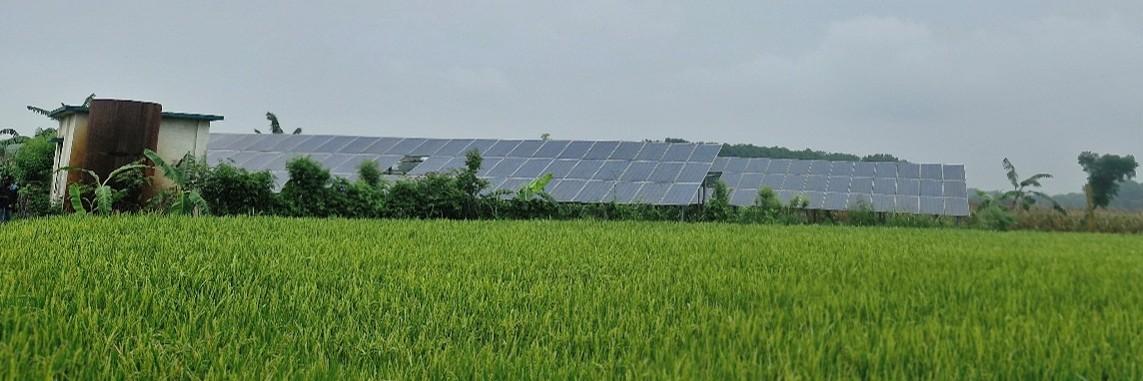
Fig-1: Solar irrigation system in Chuadanga area, Bangladesh (Photo courtesy: SMART-SIP+ project)
The Bangladesh government, working through bodies like SREDA, IDCOL, BADC, BMDA and, has set ambitious solar pump targets. IDCOL holds largest installed capacity (42.08 MWp) and most number of solar pumps (mostly in Northwestern parts), the largest share of any organization in the country. Between 2009 and 2023, solar has begun replacing diesel in the northwest, grid access has expanded nationwide, and irrigation demand has risen in coastal and central areas, with total power pump numbers spiking sharply. Yet a gap of 14,576 solar pump systems remains between the current installed base and the national roadmap target. Barriers include weak or unclear SIP business model, limited access to credit for farmers, technical performance issues during cloudy periods, and a persistent shortage of trained maintenance technicians. In short, Bangladesh is simultaneously under-investing in new solar pumps and under-using the ones it already has.
Perhaps the most compelling finding from the research involves what happens to solar energy when pumps aren't running. During the dry season, pumps operate near full capacity and utilize almost all available solar generation. But during the wet season, pumps sit largely idle, and so does the energy they could generate. Annual energy surplus from Solar Irrigation Pumps, energy that is currently generated but goes largely unused. Our recent calculation shows that average annual pump utilization stands at just 42%, meaning more than half of all solar energy potential remains untapped each year. The total annual generation from solar irrigation systems is 79.69 GWh. With utilization averaging just over half that, there is an enormous opportunity to put idle solar capacity to productive use.
The SMART-SIP+ initiative (https://smartsipplus.org/), developed by Birmingham City University, UK in collaboration Bangladesh Agricultural University with UKRI Ayrton challenge funding, proposes a radical rethinking of what solar irrigation pumps can do. Rather than treating SIPs as single-purpose water delivery tools, SMART-SIP+ envisions them as energy and service hubs at the heart of a water-energy-machinery nexus. Operating on a "Hub and Spoke" model, the approach uses pilot demonstration sites to show how surplus solar energy can power agricultural machinery, post-harvest processing, and other productive activities during the months when irrigation demand is low. This turns an underutilized seasonal asset into a year-round rural energy resource.
Bangladesh's agricultural achievements are real, but so are the threats converging on the sector. Climate change, energy insecurity, labor shortages, and rising costs demand solutions that are simultaneously practical, affordable, and environmentally sound. Solar Irrigation Pumps offer a technically proven alternative to diesel, and the SMART-SIP+ approach demonstrates how SIPs can do far more than irrigate fields. By capturing and redistributing surplus solar energy through an integrated nexus model, Bangladesh has an opportunity to reduce emissions, cut costs, and build more resilient rural communities. Realizing that potential will require bold policy action: improved financial access for farmers, stronger maintenance networks, dedicated awareness campaigns, and a serious commitment to gender inclusion in agricultural energy programs.
Bangladesh has already demonstrated its ability to overcome complex challenges and achieve extraordinary progress. Building on this strong foundation, the country is well-positioned to address the next generation of agricultural and energy challenges. By transforming its growing solar irrigation network from a seasonal irrigation resource into a year-round engine of rural development, Bangladesh can further strengthen its leadership in sustainable agriculture and create lasting benefits for future generations.
References:
Bangladesh Bureau of Statistics (BBS). (2024). Statistical Yearbook of Bangladesh 2024. Ministry of Planning, Government of the People's Republic of Bangladesh.
Bangladesh Agricultural Development Corporation (BADC). (2024). Annual Report 2023–2024. Dhaka, Bangladesh: Bangladesh Agricultural Development Corporation
Hossain M, Khatun M, Matin M, Dewan M. (2017). Postharvest loss assessment of major fruits grown in hill regions of Bangladesh. Bangladesh J Agric Res 2017;42: 171–84. https://doi.org/10.3329/bjar.v42i1.31989.
Author:
Dr. Chayan Kumer Saha
ISPA's Bangladesh Country Representative
In-Country Lead, SMART-SIP+ Bangladesh Project
and Professor, Department of Farm Power and Machinery
Bangladesh Agricultural University
Mymensingh-2202
Bangladesh
Email: cksaha@bau.edu.bd
Dr. Chayan Kumer Saha
ISPA's Bangladesh Country Representative
In-Country Lead, SMART-SIP+ Bangladesh Project
and Professor, Department of Farm Power and Machinery
Bangladesh Agricultural University
Mymensingh-2202
Bangladesh
Email: cksaha@bau.edu.bd